Traitors at the Round Table: 3 Litigation Tactics to Spot a Liar
How courtroom cross-examination techniques can reveal deception — in fiction and in life.
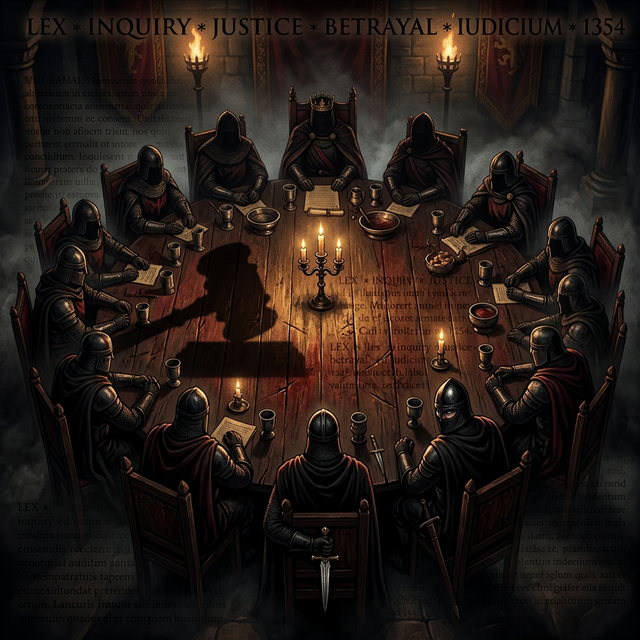
There’s a reason the Arthurian legends have endured for centuries: they are stories about trust, betrayal, and the devastating cost of believing the wrong person. Lancelot at the Round Table. Mordred smiling as he sharpened his blade. The traitor was always there, sitting among the loyal, breaking bread with the very people he would betray.
It turns out, modern litigation lawyers deal with this exact problem every single day — and they’ve developed some devastatingly effective tactics for unmasking the liars in the room.
As a thriller writer, I find the courtroom endlessly fascinating. It’s a stage where deception and truth do battle under formal rules, and where skilled litigators have honed techniques that fiction writers can steal shamelessly.
Here are three of my favourites.
1. The Closed-Loop Question
A skilled litigator never asks “What happened?” That’s an open door — an invitation for the witness to construct whatever narrative suits them. Instead, they use closed-loop questions: tight, specific queries that demand a yes or no.
“You were at the house on the night of March 3rd, weren’t you?”
“You spoke to Mr. Hale before the meeting, didn’t you?”
The beauty of the closed-loop is that it strips away the liar’s favourite weapon: context. Liars love to contextualise — to pad their answers with qualifiers, justifications, and tangential details that muddy the waters. A closed-loop question forces them into a corner. They must commit to a fact or deny it outright. And every commitment becomes a brick in the wall that will eventually box them in.
In fiction, this is gold. Think of the interrogation scene where your detective shifts from casual conversation to rapid-fire, precise questions. The moment the suspect starts to squirm under that pressure — that’s when the reader knows the net is closing.
2. The Prior Inconsistent Statement
This is the classic “gotcha” — but in the hands of a master litigator, it’s far more surgical than dramatic. The technique works like this: you let the witness testify freely, giving them plenty of rope. Then, at the critical moment, you produce a prior statement — an email, a text message, a previous deposition — that directly contradicts what they’ve just said.
The key is timing. An amateur springs the contradiction immediately. A professional waits. They let the witness repeat the lie, commit to it, double down on it. Only then do they reveal the inconsistency.
Why? Because each repetition of the lie makes the contradiction more devastating. The witness hasn’t just misspoken — they’ve insisted on a falsehood. The jury doesn’t just see an error. They see intent.
For thriller writers, this technique is the backbone of any great reveal. Think of your antagonist weaving their web of lies across chapters, growing more confident with each telling — until the one piece of evidence surfaces that brings it all crashing down. The longer the lie has been sustained, the more satisfying the collapse.
3. The Behavioural Baseline
Experienced litigators know that you can’t spot deception from a single gesture or verbal tic. Instead, they establish a behavioural baseline early in examination. They ask simple, non-threatening questions — questions they already know the answers to — and carefully observe how the witness behaves when telling the truth.
How do they sit? Where do their eyes go? What’s their speech pattern? How quickly do they respond?
Then, when they move to the critical questions — the ones where deception is likely — they watch for deviations from that baseline. A sudden increase in speech rate. A shift in posture. A new tendency to begin answers with “Well…” or “To be honest…”
This is perhaps the most useful technique for fiction. As writers, we can weave these behavioural shifts into our prose with exquisite subtlety. A character who has been relaxed and forthcoming suddenly starts fidgeting. Their sentences become longer, more convoluted. They begin over-explaining. The reader picks up on these shifts subconsciously, building that delicious sense of unease.
The Writer’s Advantage
Here’s the thing that makes fiction writers luckier than any litigator: we control both sides. We know who’s lying and who isn’t. We get to plant the clues, time the reveals, and orchestrate the moment of exposure with surgical precision.
The courtroom gives us a masterclass in the mechanics of deception. The Round Table reminds us of the emotional stakes. Combine them, and you have the ingredients for a thriller that keeps readers guessing until the very last page.
After all, the most dangerous traitor is never the one you suspect. It’s the one sitting right beside you, pouring your wine.